Ming
MING 57.05 Comet
MING 57.05 Comet
無法載入取貨服務供應情況
Nine years of MING, and a new approach to worldtime
To mark our ninth anniversary, we’re introducing the MING 57.05 Comet, a new worldtimewatch built for the realities of life across time zones.
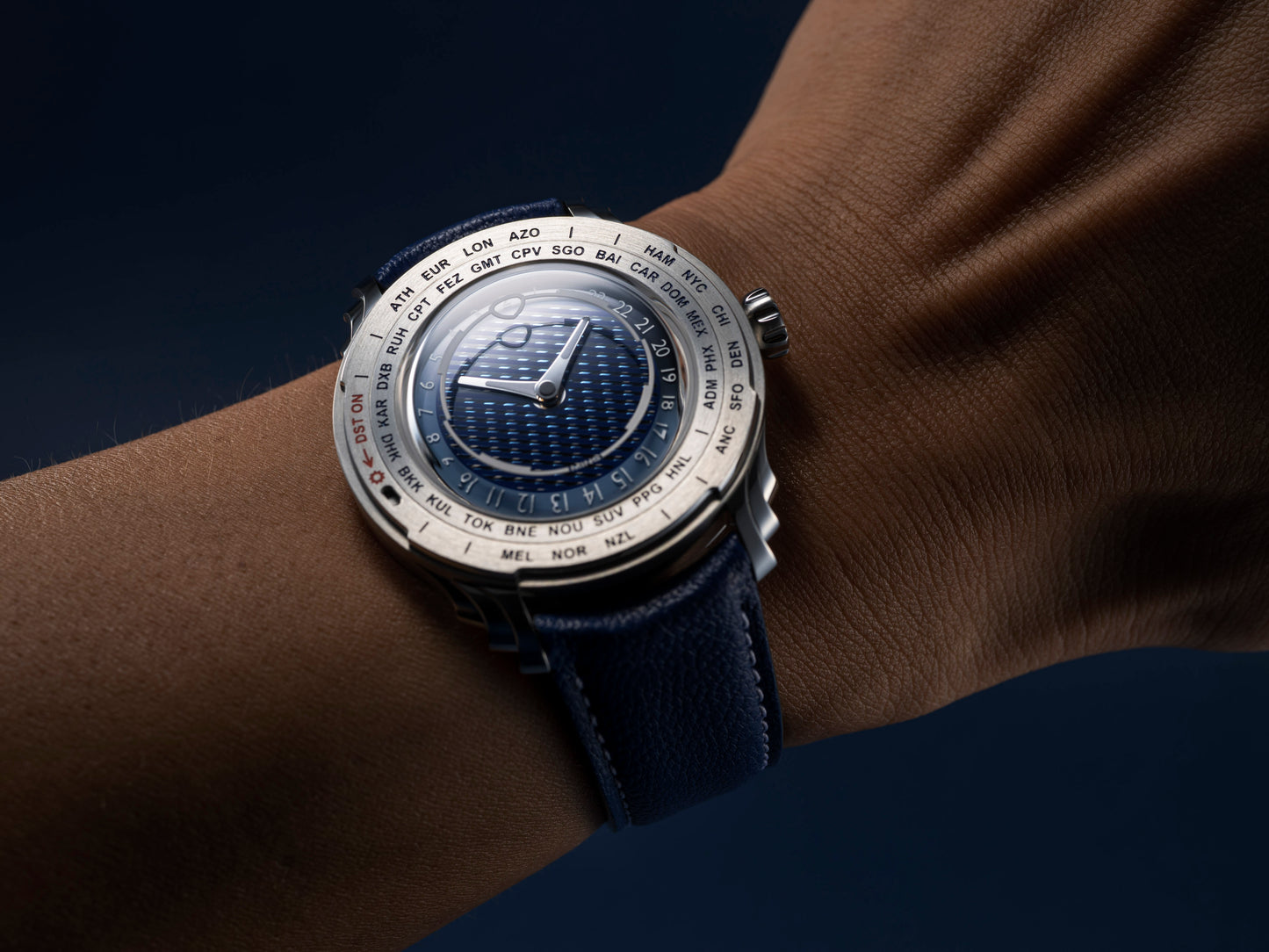
The 57.05 features a first-of-its-kind, patent-pending system for adjusting the worldtime to account for daylight saving time (DST). Built around our fifth-generation design language, it revisits one of our favorite complications in a new 40mm stainless-steel format and is alsoour most accessible worldtime watch to date.
The 57.05 Comet takes its name from the de Havilland Comet, the world’s first commercial jet airliner. We have always been fascinated by the engineering and style of early commercial aviation. The same era also saw Geneva-based watchmaker Louis Cottier develop a worldtime system for wristwatches that would define the complication for generations.
Entering passenger service with the British Overseas Airways Corporation in 1952, the de Havilland Comet helped usher in the jet age and a new era of international travel, making it possible to go faster and farther in an increasingly interconnected world. Today, with the MING team spread across four countries and several regions of the world, international travel is less a romantic notion for us than a practical necessity.*
The 57.05 Comet is our contemporary take on a complication born for exactly this kind of world.
A Different Approach to DST
Traditional worldtime watches work beautifully with standard time. Daylight saving time complicates the picture. A conventional 24-hour worldtime display shows the standard time across the world’s major cities at a glance, but seasonal changes still leave you accounting for the extra hour yourself.
Our solution is mechanical, tactile, and deliberately simple.
The cities featured on the 57.05 Comet are divided according to whether they observe daylight saving time. Cities unaffected by DST remain fixed on the inner bezel, while those that observe it are positioned on a separate outer bezel. Rotating the outer bezel a single click, exactly 15 degrees, moves only the relevant cities forward by one hour against the 24-hour scale.
The bezel locks positively into either its standard-time or DST position using a spring-loaded ball and corresponding recesses beneath the bezel. A small aperture labeled DST ON, positioned between eight and nine o’clock on the bezel, provides an immediate visual confirmation: silver for standard time and red for DST.
Distinct grip points are machined into the edge of the outer bezel, making the DST adjustment easier to execute and giving the mechanism a more deliberate, tactile feel.
With a single click, our patent-pending system adjusts the cities that observe daylight saving time without disturbing those that don’t. No spreadsheets, calculators, or mild existential confusion required.
A Dial That Refuses to Sit Still
The worldtime display isn’t the only part of the 57.05 Comet that changes with time.
At the center of the watch is a multilayered blue dial with overlapping raster structures that create an animated interference pattern we call the Comet Tail.
A raster is a repeating grid of lines or openings. When two such grids overlap, small changes in their alignment create much larger visual patterns. As the relationship between the layers gradually shifts, the dial appears to flow and evolve over the course of the day rather than presenting a single static texture.
The result? A dial that reveals something different with nearly every glance.
Surrounding the central dial is the rotating 24-hour indication. At night, the entire display changes character again. The handset uses blue-emission Super-LumiNova X1, while the 24-hour scale uses blue emission for daytime hours and orange for nighttime hours. When daylight saving time is active, the DST ON indicator dot will also glow red in the dark.
Above the dial, the floating box-style top crystal is laser-engraved and filled with our proprietary MING Polar White luminous material, creating white-emission markers for the primary 12-hour indices.
Case, Calibre & Construction
The 57.05 Comet belongs to our fifth-generation design language, recognizable by its triple-stepped lug architecture.
The 40mm × 10.3mm case is machined from 316L stainless steel, combining Art Deco references with the more sculptural forms of our latest aesthetic framework.
Nowhere is that clearer than the lugs. No fewer than nine individual components are required for the lug construction alone. This multi-piece approach allows adjacent surfaces to receive sharply differentiated brushed and polished finishes that would be impossible to achieve with the same definition using conventional case construction.
For all of that complexity, the 57.05 remains a watch intended to travel. The case offers 100 meters of water resistance and is paired with either a cobalt blue goat leather strap from Jean Rousseau Paris or our signature MING Polymesh in titanium.
The sapphire crystal exhibition caseback reveals the self-winding Sellita for MING calibre 330.M2, offering approximately 50 hours of power reserve. The movement features skeletonized bridges with brushed finishing and an anthracite coating, set over a matching anthracite-coated baseplate.
Pricing & Availability
The 57.05 Comet marks nine years since the first MING watches debuted. It brings together several ideas that have become increasingly important to us along the way: unconventional case construction, displays that change with light and time, real-world usability, and a willingness to rethink familiar complications rather than simply reproduce them.
The MING 57.05 Comet will be produced in a limited edition of 200 examples and is priced at CHF 6,950 on a leather strap, or CHF 7,950 on MING Polymesh.